7 Best Tools for Founders Building in Public (2026 Guide)
Building in public is one of the fastest ways to attract early users, build trust, and stay accountable.
But there is one problem.
The updates you spend months sharing end up scattered across different platforms. Tweets disappear. Milestone posts get buried. Notes stay private. Before long, even you have trouble looking back at how far you've come.
After building publicly myself, these are the tools I've found genuinely useful. Each solves a different problem, and together they make a simple system you can actually stick with.
You don't need every tool on this list. You just need the right combination for where you are today.
No affiliate links. No sponsored placements. Just an honest review.
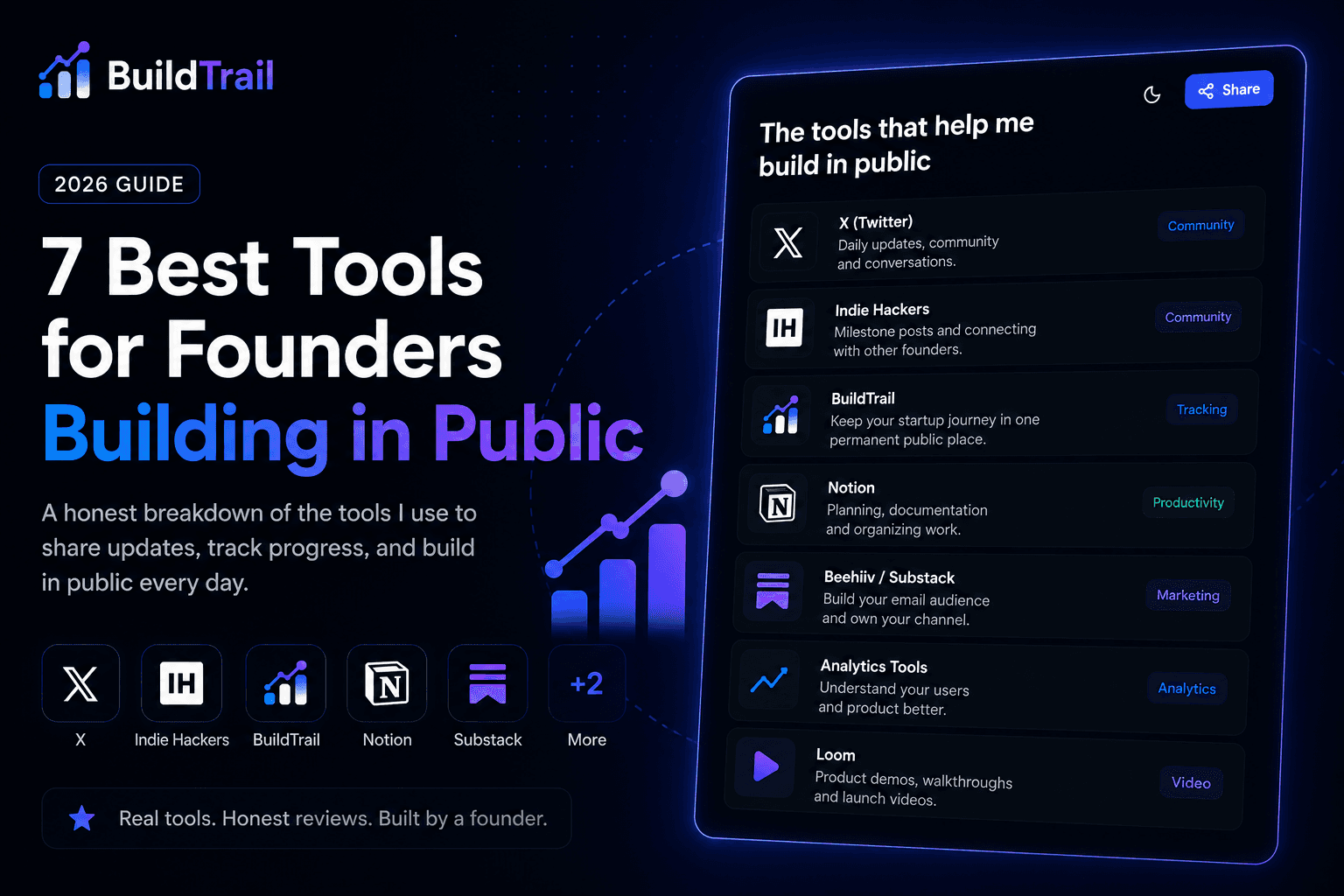
Quick comparison
| Tool | Best for | Biggest limitation |
|---|---|---|
| X | Daily updates and community | Posts disappear quickly |
| Indie Hackers | Milestones and founder discussions | Not designed for frequent updates |
| BuildTrail | Permanent public startup journey | Works best alongside social platforms |
| Notion | Internal planning and documentation | Poor public experience |
| Beehiiv / Substack | Newsletters and email audience | Requires consistency and an audience |
| Plausible / Fathom / Google Analytics | Product analytics | Doesn't tell your story publicly |
| Loom | Product demos and launch videos | Videos are difficult to search |
1. X
Best for
Daily updates, networking, and finding your audience.
If you're building in public, this is where most conversations happen.
Founders share progress, launch features, celebrate wins, talk openly about failures, and help each other solve problems. A single post can bring feedback, customers, partnerships, or simply motivation to keep going.
There really isn't another platform that matches the speed and reach of X for founders.
Where it falls short
Everything disappears.
Even great posts become difficult to find after a few days. Someone discovering you today has almost no way to see the journey you've documented over the last six months without endlessly scrolling your profile.
X is amazing for discovery.
It is not where your story should live permanently.
2. Indie Hackers
Best for
Milestone posts and connecting with other founders.
Indie Hackers has one of the most thoughtful startup communities online. People genuinely read longer posts, leave useful comments, and ask meaningful questions.
Whenever you launch a feature, reach your first customers, or hit an important milestone, it's worth sharing there.
Where it falls short
It isn't built for daily updates.
Writing every small improvement as a full Indie Hackers post quickly becomes exhausting. Most founders naturally end up posting only major milestones.
Think of it as your monthly journal rather than your daily log.
3. BuildTrail
Best for
Keeping your startup journey in one permanent place.
After using X, Indie Hackers, and Notion together, I realized something was missing.
There wasn't one place where my startup story actually lived.
Tweets disappeared.
Notion stayed private.
Indie Hackers only captured occasional milestones.
That's the problem I wanted BuildTrail to solve.
Instead of replacing social platforms, it works alongside them. I still post on X first. BuildTrail is simply where those updates live permanently and stay organized over time.
Whenever you launch something, reach a milestone, gain new users, or ship a feature, you add it to your BuildTrail page.
Over time it becomes a public timeline of your startup.
Visitors can quickly understand what you're building, how you've progressed, and where you are today without digging through months of old posts.
It brings together your milestones, product updates, founder stage (Idea, Building, Testing, Launch, or Growth), and key metrics into one public page you can share anywhere.
Instead of sending someone a collection of tweets, changelogs, and profiles, you simply share one link.
For me, that's what makes building in public much easier to sustain over time.
4. Notion
Best for
Planning, documentation, and organizing your work.
Notion is still one of my favorite tools for internal use.
Roadmaps.
Meeting notes.
Ideas.
Feature planning.
Documentation.
It does all of those really well.
Many founders also try using Notion as a public changelog or startup homepage because it's quick to set up and familiar to use.
Where it falls short
Notion wasn't designed to be your public startup page.
Shared pages feel like internal documents.
The URLs aren't memorable.
There is no discovery.
There is no community.
If your goal is simply organizing your thoughts, Notion is excellent.
If your goal is documenting your startup publicly, there are better options.
5. Beehiiv or Substack
Best for
Building an email audience.
One thing every founder eventually realizes is that followers are borrowed.
Email subscribers are yours.
A newsletter gives you a direct connection with people interested in your journey, independent of social media algorithms.
Beehiiv offers stronger growth features and referral tools.
Substack has a larger built-in reader community.
Both are excellent choices.
Where they fall short
Writing a newsletter every week takes commitment.
If you're just starting with zero readers, it's often better to focus on building an audience first before investing heavily in email.
Start the newsletter once people are already interested in what you're building.
6. Analytics tools
Plausible, Fathom, Google Analytics
Best for
Understanding how people use your product.
Analytics help answer questions like:
- Where are users coming from?
- Which pages convert best?
- What features are people actually using?
- Which marketing channels work?
Plausible and Fathom are simple and privacy friendly.
Google Analytics offers much deeper reporting if you need it.
Where they fall short
Analytics explain your product.
They don't explain your journey.
They show numbers, but they don't capture the story behind those numbers.
7. Loom
Best for
Product walkthroughs and launch announcements.
Sometimes a short video explains more than paragraphs of text.
A quick Loom recording showing your latest feature feels personal and authentic.
It's one of the easiest ways to build trust with early users.
Where it falls short
Videos are difficult to search.
People rarely go back and watch months of old recordings.
They're best used for important launches rather than every small update.
The stack I'd recommend
If you're just getting started, don't try to use everything.
Here's a simple setup that works well.
- X for daily updates and conversations.
- BuildTrail for keeping your journey permanently documented.
- Indie Hackers for milestone posts.
- Beehiiv or Substack once you've built an audience.
- Loom for launches and product demos.
- Analytics to understand your users.
That's more than enough.
Consistency beats complexity every time.
Your story deserves more than a timeline
One thing I've learned while building in public is that people rarely discover you on day one.
Most people find your product months later.
When they do, they're usually curious about how you got there.
They don't just want to know what you're building.
They want to know how you built it.
If your journey only exists across hundreds of old posts, they'll probably never see it.
Having one place that captures your milestones, product updates, metrics, and progress makes it easier for new users, customers, and other founders to understand your story.
That's exactly why I decided to build BuildTrail.
Not to replace X or Indie Hackers, but to become the place where the entire journey lives.
If you're already sharing your progress online, don't let your story disappear into the timeline. Create a free BuildTrail page and give your startup journey a permanent home.