
How to Track Your Startup Progress Without Losing Your Mind
You are building a startup. Maybe even a SaaS. You have a product, a few users, maybe some revenue. And somewhere between shipping features, talking to customers, and trying to grow, you are supposed to be tracking your progress too.
Most founders handle this badly. Spreadsheets that never get updated. Notion pages that made sense three months ago but now nobody opens. Numbers scattered across five different tools with no single view of how things are actually going.
This article is about fixing that. A simple, practical system for tracking what matters and sharing it publicly without it becoming another thing on your to-do list.
Why Most Founders Lose Track of Progress
The honest answer is that tracking feels like admin. When you are deep in building mode, opening a spreadsheet to update your user count feels like a distraction from the actual work.
But here is the thing. When you do not track, you lose visibility. You stop seeing trends. You cannot tell if things are improving or getting worse. And when you go to make important decisions about what to build next or whether to keep going, you are working from gut feeling instead of actual data.
Tracking is not admin. It is how you know if what you are doing is working.
What to actually track
Most founders track too many things or the wrong things. Here is what actually matters at the early stage.
Monthly Recurring Revenue (MRR) is the most important number for any subscription business. It tells you how much predictable income you are generating each month. Track it weekly, not just monthly, so you can see the trend clearly.
Total users and active users are two different numbers. Total users is vanity. Active users tells you if people are actually finding value in what you built. Track both but pay more attention to active users.
New signups per week shows whether your top of funnel is working. If this number is flat or dropping, you have a discovery problem. If it is growing but active users are not, you have an activation problem.
Churn is the number of users or customers who stopped using your product each month. High churn is a signal that something is wrong with the product or the onboarding. Low churn means people are finding real value.
Key milestones are the qualitative markers that matter to your specific journey. First paying user. First ten users. First month of profitability. First user who came from organic search. These are the moments worth documenting even if they do not show up in a spreadsheet.
The problem with spreadsheets
Spreadsheets work fine for tracking numbers. The problem is that they are private, static, and boring.
Nobody sees your spreadsheet. Your audience does not know what is happening with your product. Potential users cannot see whether you are actively building or whether the project has been abandoned. And you have no incentive to keep it updated because there is no accountability.
When your tracking is private, it is easy to skip a week. Then two weeks. Then you stop entirely and six months later you have no idea what your user count was in March.
Why public tracking works better
When you track publicly, something changes.
You update your numbers because people are watching. Not out of pressure but out of accountability. You start seeing your own progress more clearly because you are documenting it for someone else to understand.
Your audience gets to follow the real journey. Potential users can see you are actively building. Investors can see traction. Other founders can learn from your experience.
And when you look back in six months, you have a complete record of where you started and how far you have come.
A simple weekly tracking routine
This takes less than ten minutes per week.
Every Monday morning, update five numbers. Your MRR or revenue, your total users, your new signups from last week, your active users, and any significant milestone or event from the previous week.
Write two or three sentences about what happened. What you shipped, what worked, what did not. No need to be long or polished. Just honest and specific.
Share it publicly. On Twitter, on your build-in-public page, wherever your audience hangs out.
That is it. Ten minutes. Once a week. Done consistently for a year, this builds something genuinely valuable.
Where to keep your tracking data
This is where most founders run into trouble. Options include Notion, spreadsheets, Twitter threads, personal blogs, and various analytics tools. Each has limitations.
Notion pages are great for your own reference but bad for public sharing. Spreadsheets are private and static. Twitter threads disappear. Personal blogs require too much setup.
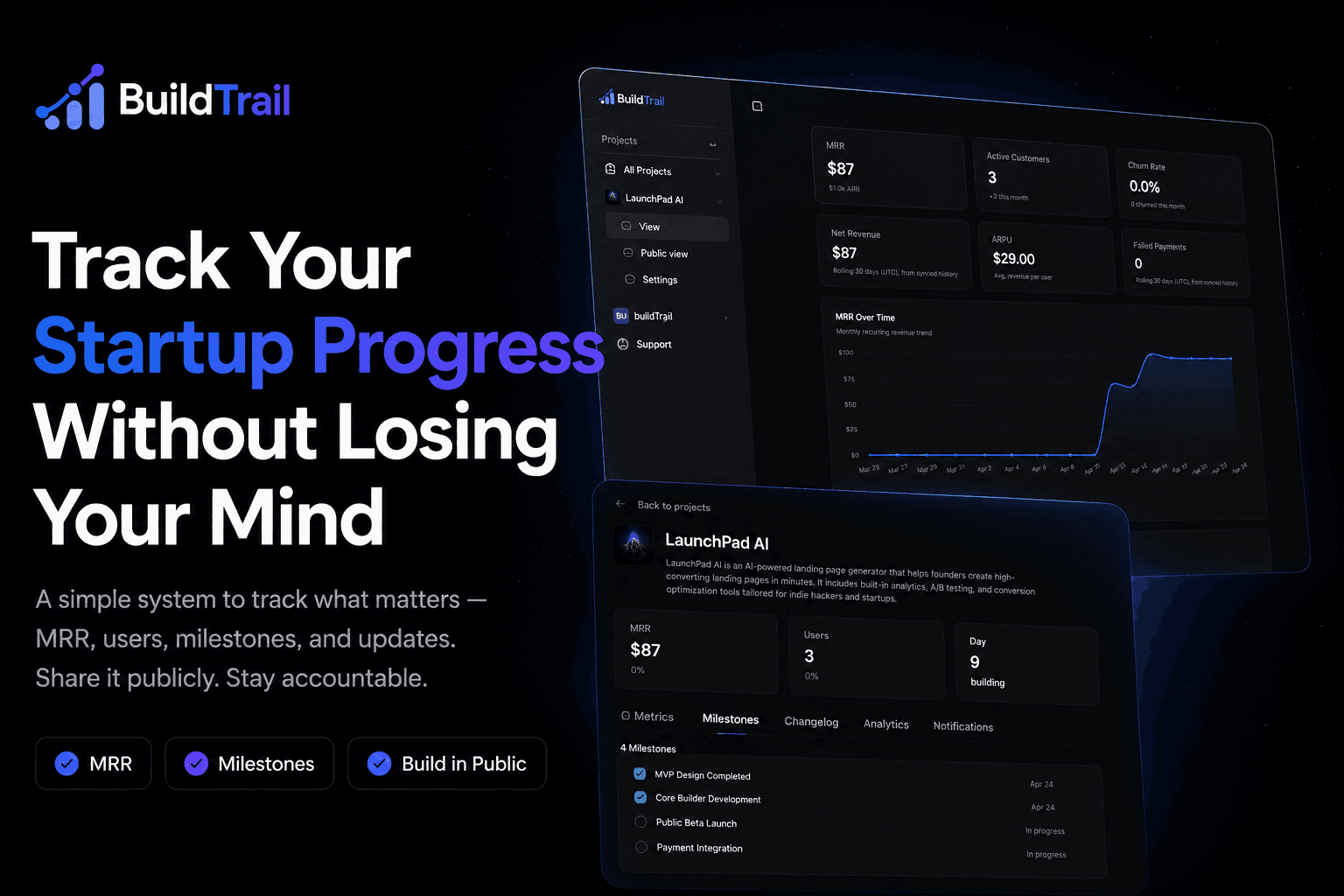
After trying spreadsheets, Twitter threads, and scattered notes, I realized there wasn’t a simple place to track startup progress publicly in one place. That’s why I built BuildTrail — one public page where you can track your MRR, users, milestones, and updates, and share it all with a single link. Your journey lives permanently in one place instead of scattered across tools and tweets.
You can see an example of how it works at buildtrail.app
The mindset shift that makes tracking valuable
Stop thinking of tracking as something you do to report to someone else. Start thinking of it as something you do for your future self.
The founder who tracked consistently for twelve months has something the founder who winged it does not. A clear picture of what actually happened. Evidence of progress even when it felt like nothing was working. A story they can tell potential users, investors, and collaborators that is backed by real data.
That story is worth more than you think.
Start simple
If you take nothing else from this article, take this. Start tracking one number this week. Just one. Update it every Monday. Share it publicly somewhere.
That is the whole system in its simplest form. Add more over time as the habit builds. But do not wait until you have the perfect system before you start. The founders who win at this are the ones who started imperfectly and kept going.
Your startup journey is already happening. The question is whether you’ll remember it six months from now.
Start tracking your progress publicly with Buildtrail.